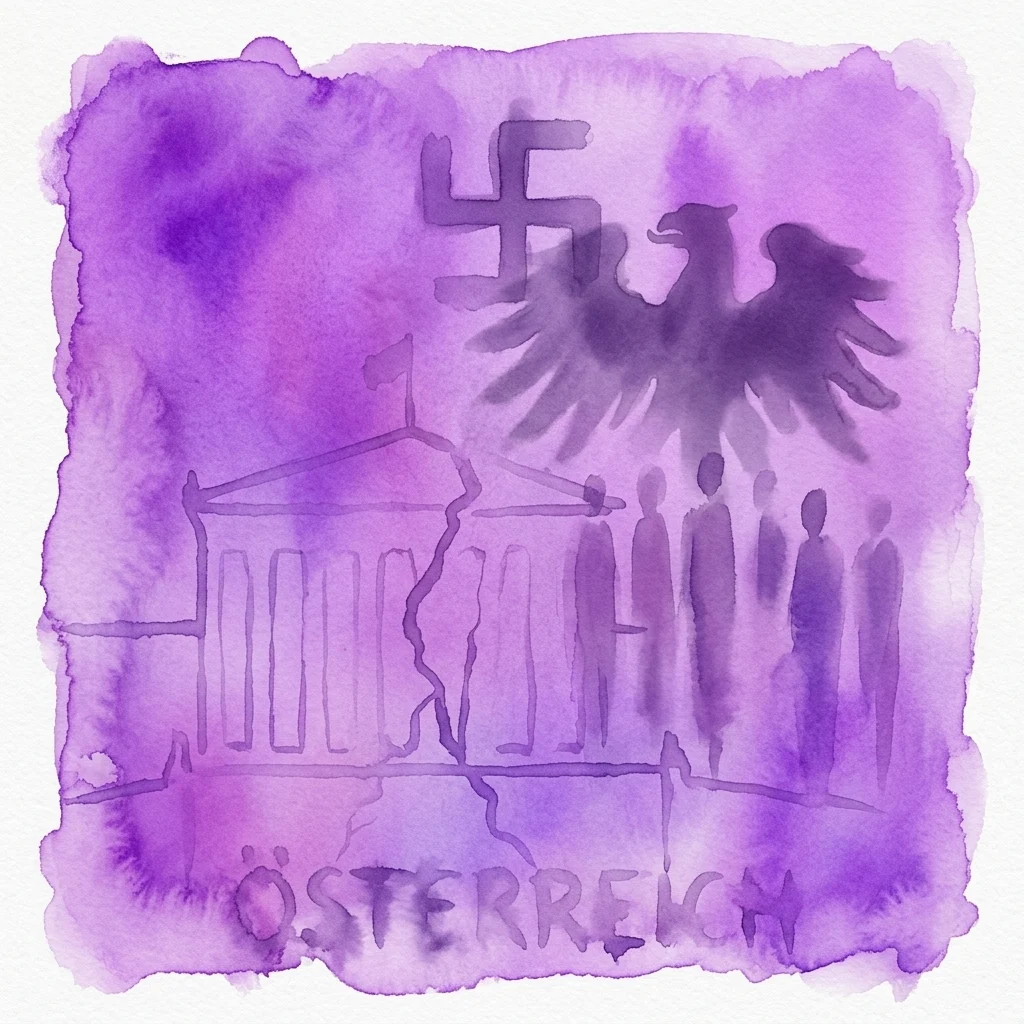
This historical account details the 'Declaration of Independence of Austria' and the subsequent founding of the Second Republic in 1945. It covers the proclamation by the provisional state government, the establishment of Austria as a democratic republic, and the political context of the time, including the rejection of responsibility for National Socialism.
The page focuses on the critical events of 1945 leading to the formation of Austria's Second Republic, centering on the 'Declaration of Independence of Austria'. It highlights the proclamation made by the provisional state government, formed by SPÖ, ÖVP, and KPÖ, which declared the re-establishment of Austria as a small state within its 1937 borders shortly after the liberation of Vienna and before the end of World War II. The text, largely drafted by SPÖ State Chancellor Karl Renner, defines Austria as a democratic republic and refers to the 1920 constitution as the benchmark for its re-establishment. A significant point emphasized is the declaration's rejection of any political responsibility of Austrian society for National Socialism, the Second World War, and the Holocaust, thereby enshrining the 'victim myth' of the Second Republic. The text also notes the initial prospect of a "retribution law" against former members of the NSDAP and SS responsible for the regime of violence and the war. Following two inter-state conferences, the Western federal states, the USA, Great Britain, and France recognized the expanded state government, which then proceeded to prepare for the first National Council elections on November 25, 1945.