Delve into the artistic process and historical context of Escher's significant 'Fish and Birds' ceramic work.
This detailed entry explores the fascinating history behind M.C. Escher's 1960 ceramic tile tableau, 'Vissen en vogels'. Commissioned for an Amsterdam villa, this work beautifully translated Escher's transformation print 'Lucht en water I' into a distinctive applied art form. Learn about the collaboration with De Porceleyne Fles and its enduring inspiration for the renowned artist.
About Een tegeltableau voor én door Escher at Bijbels Museum (Cromhouthuizen) in Amsterdam
Read curatorial context and practical visitor information for Een tegeltableau voor én door Escher at Bijbels Museum (Cromhouthuizen) in Amsterdam
Exhibition summary
This article details a significant ceramic tile tableau by M.C. Escher, titled 'Vissen en vogels' (Fish and Birds), created in 1960. The piece, which was acquired by Escher in Het Paleis and Kunstmuseum Den Haag, was originally commissioned for a villa facade and is based on Escher's transformation print 'Lucht en water I'. The tableau was produced by De Porceleyne Fles and served as a personal inspiration for Escher, prominently displayed in his atelier.
Curatorial context
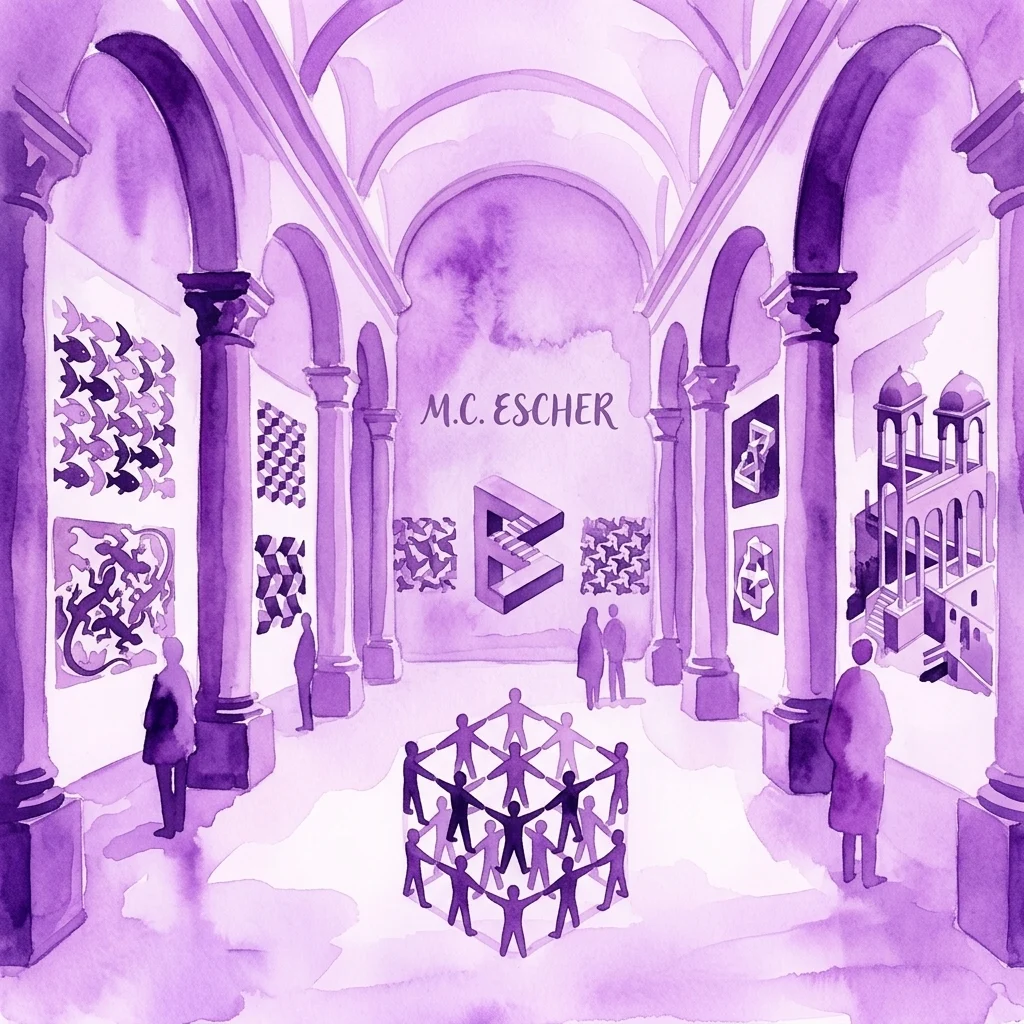
Escher in Het Paleis and Kunstmuseum Den Haag have enriched their collection with a personal work by M.C. Escher: the tile tableau 'Vissen en vogels' from 1960, which hung in Escher's atelier for years. This tableau was created following a major commission in the winter of 1959-1960 for the facade of a villa in Amsterdam-Zuid, commissioned by Wolbert J. Vroom. Escher proposed basing the design on his print 'Lucht en water I' (1938), where fish gradually transform into birds. The diamond-shaped design adds dynamism to the villa's straight lines, and Escher's tessellations were well-suited for a tile pattern.
The Delft pottery factory De Porceleyne Fles was involved in its creation. Escher had collaborated with them previously on tiled columns for schools. After a months-long process, the tableau was delivered in the spring of 1960, with the Vrooms, architect Lau Peters, and M.C. Escher present at the unveiling. The large tile tableau on Dirk Schäferstraat remains visible on the building's facade today. Escher was so pleased with the result that he gratefully received a smaller tableau with the same tiles from De Porceleyne Fles, writing in a letter on March 15, 1960, about his anticipation. He gave this smaller tableau a prominent place in his atelier, where it hung for many years and was photographed with him multiple times. It later moved with him to the Rosa Spier Huis in Laren, where he spent the final phase of his life.
Admission and ticket notes
The museum's primary ticketing link is available for purchasing tickets to the museum, which houses this significant artwork. Visitors are directed to the official ticketing website for details and booking: https://tickets.escherinhetpaleis.nl/nl/tickets
Een tegeltableau voor én door Escher key exhibition facts
Review exhibition status, schedule, venue context, and attribution details for Een tegeltableau voor én door Escher at Bijbels Museum (Cromhouthuizen) in Amsterdam
Venue
Bijbels Museum (Cromhouthuizen)
Current status
Open now
Exhibition schedule
From Jan 1, 1960
Artist line / attribution
M.C. Escher (design), De Porceleyne Fles (execution)
Amsterdam
Find Engaging Exhibitions in Amsterdam for a Rich Cultural Exploration
Explore Amsterdam's dynamic schedule of art and heritage exhibitions.
Navigate Amsterdam's exhibition landscape to discover captivating showcases across various themes and venues. Delve into temporary displays, special collections, and cultural events. Plan your visits to experiences that intrigue you.