Madrid
Aranjuez · Royal History & Gardens

Royal Palace of Aranjuez: A Grand Royal Site

Explore this historic royal summer residence and its famous gardens in Aranjuez.

HistoryArchitectureDesignLocal heritage

Explore the lavish state rooms, exotic chambers, and vast landscaped gardens of this former country residence of Spanish royalty. The palace is part of the Aranjuez Cultural Landscape, a designated UNESCO World Heritage site known for its historical and natural beauty.

Discover the Royal Palace of Aranjuez, a World Heritage site featuring opulent royal interiors and extensive, historically significant gardens where Spanish monarchs spent their spring seasons.

Royal Palace of Aranjuez
Royal Palace of Aranjuez Overview

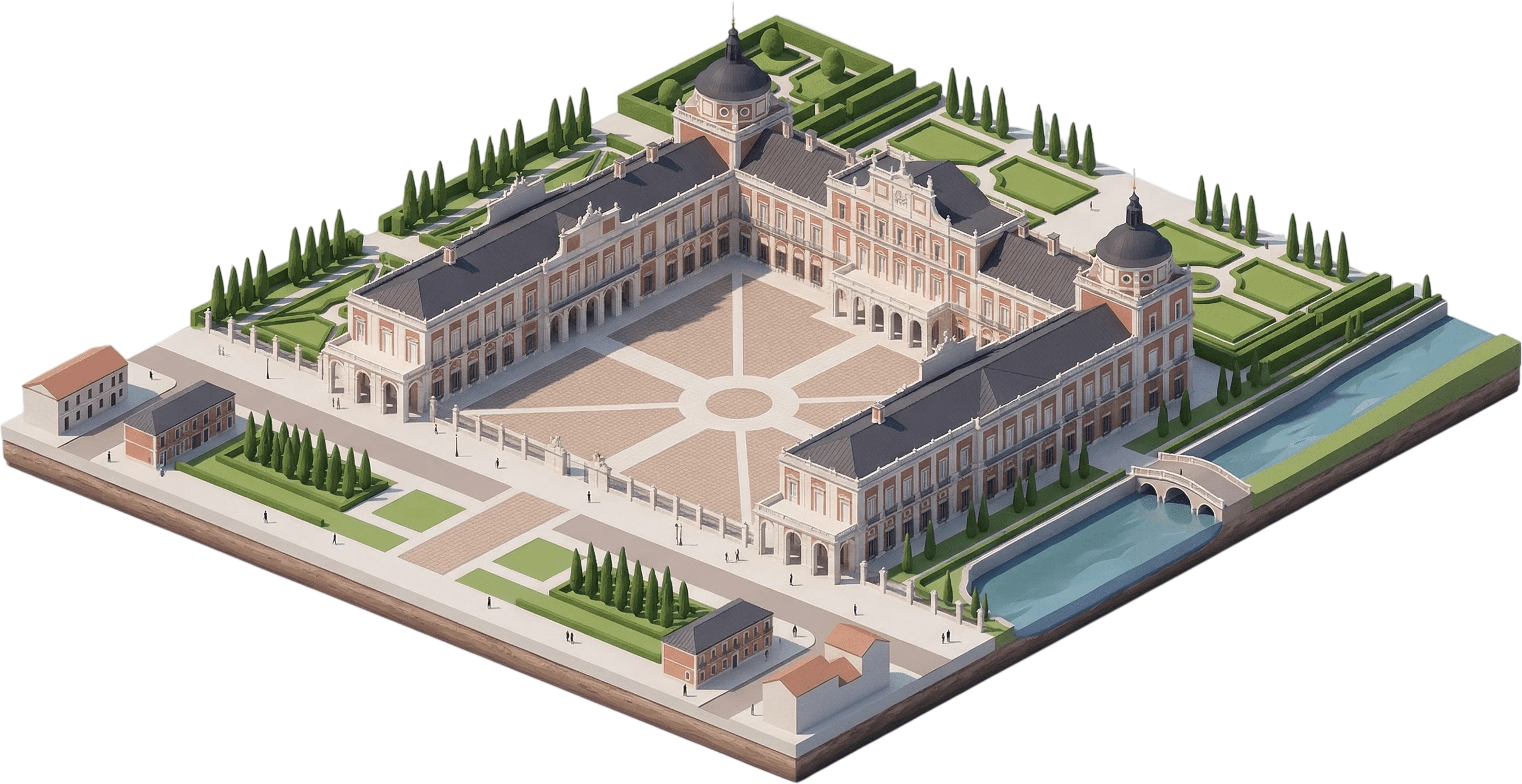
The Royal Palace of Aranjuez, located in Aranjuez, served as a grand country residence for Spanish kings and queens. This extensive complex, recognized as a UNESCO World Heritage Site, features over 111 hectares of historically significant gardens alongside its opulent palace. Visitors can explore interiors showcasing a blend of Hapsburg classicism and Bourbon-era grandeur, including unique spaces like the Arabic and Porcelain Rooms.

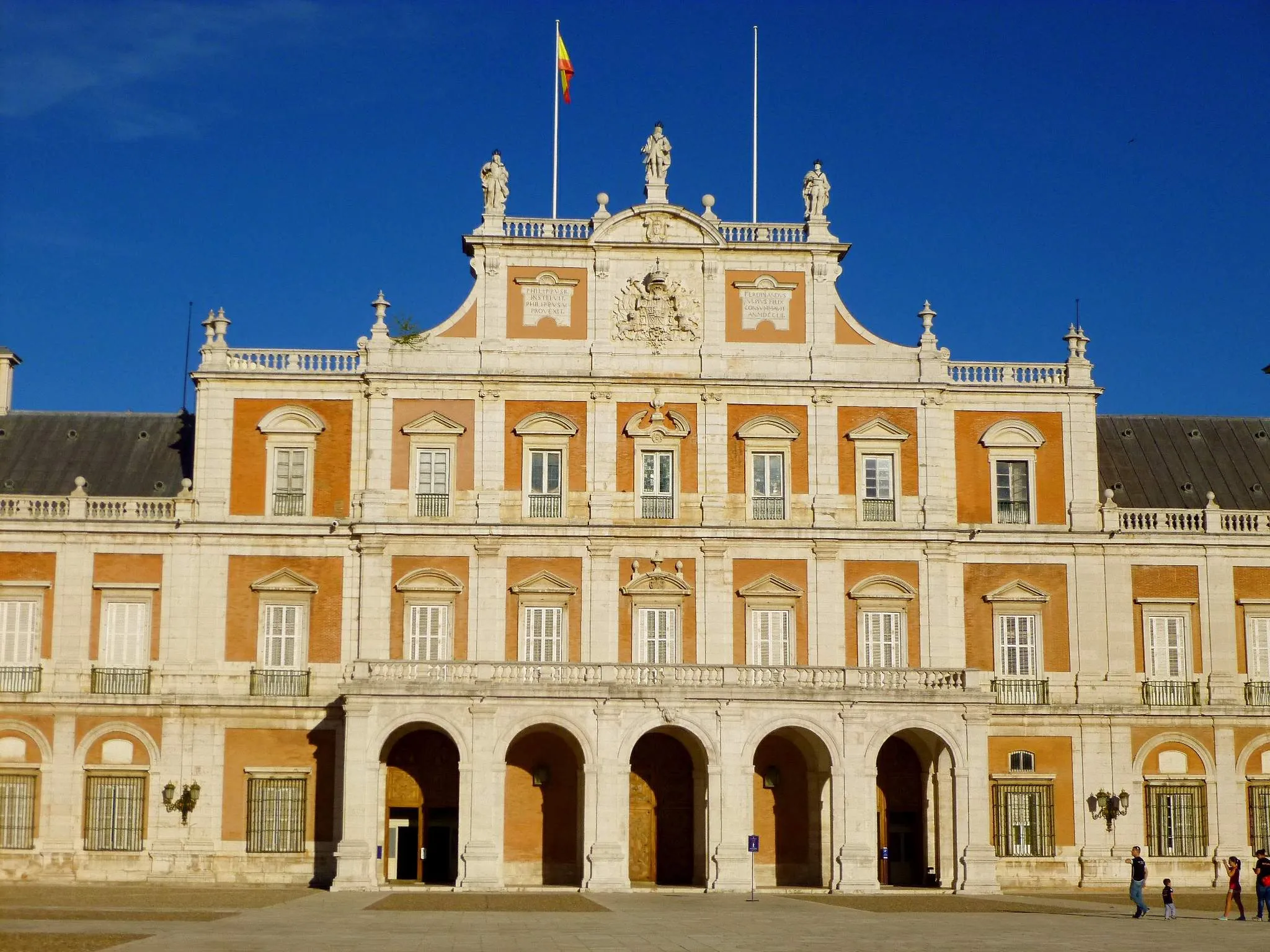
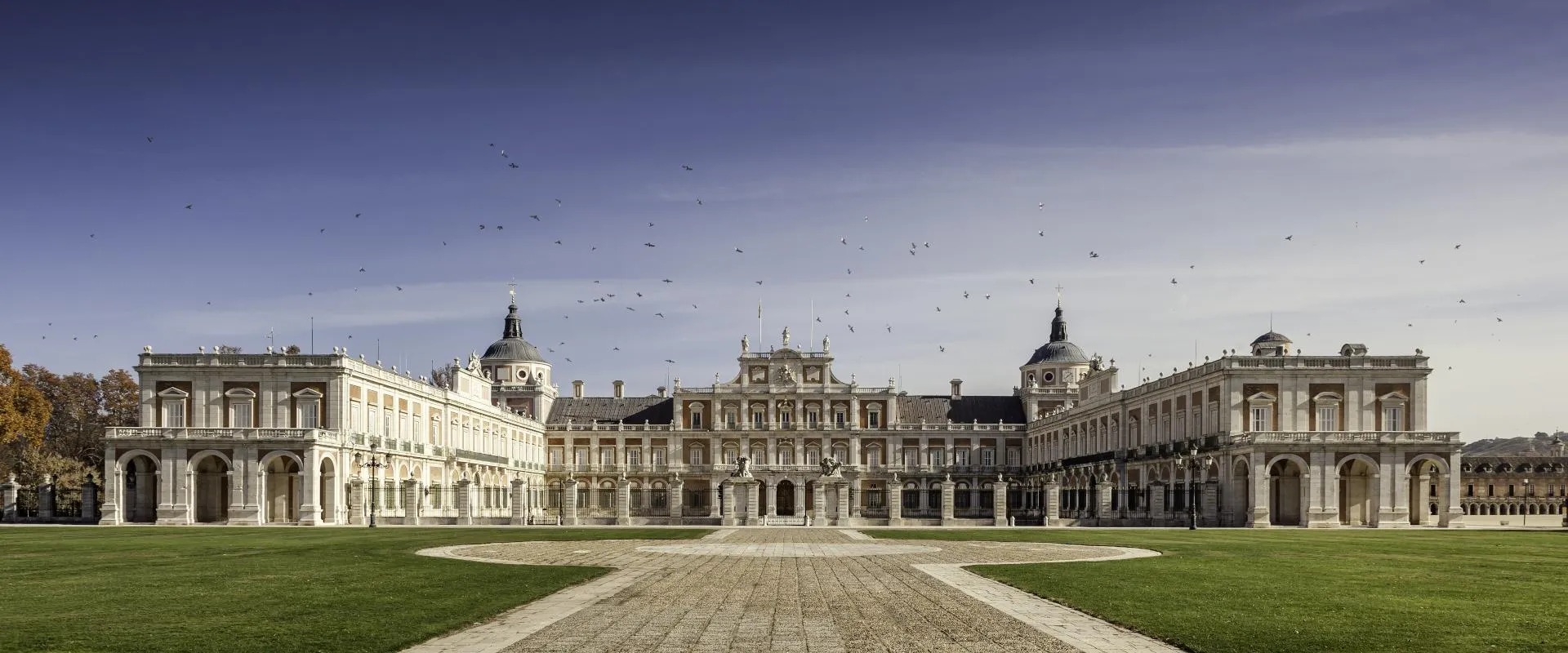
The Royal Palace of Aranjuez with its ornate facade, arched entrances, and a Spanish flag flying atop the building.
Royal Palace of Aranjuez opening hours in Madrid

Check today’s opening status, weekly schedule, and special date changes for Royal Palace of Aranjuez. Use these opening hours to plan your arrival and avoid closed times in Madrid.

Monday
Tuesday
Wednesday
Thursday
Friday
Saturday
Sunday
-
10:00-19:00
10:00-19:00
10:00-19:00
10:00-19:00
10:00-19:00
10:00-19:00
Royal Palace of Aranjuez Tickets and Admission

Admission to the Royal Palace of Aranjuez offers various categories for visitors. Standard adult tickets are available, alongside reduced-price options for seniors aged 65 and above, and students up to 25 years old who present valid identification. Children aged 0-4 years receive free entry, while children aged 5-16 require a paid ticket. Please note that group tickets are not offered for entry to the palace.

Standard Admission (Self-Guided)
€9.00

Standard adult ticket for visitors not eligible for discounts. Self-guided tour of the Royal Palace.

Reduced Admission (Ages 5–16, Self-Guided)
€4.00

Accreditation by means of identification card or passport required from 14 to 16 years of age. Self-guided tour.

Reduced Admission (Seniors 65+, Self-Guided)
€4.00

For persons over 65 years of age. Self-guided tour.

Royal Palace of Aranjuez Location

The Royal Palace of Aranjuez is situated at Pl. de Parejas in Aranjuez, a city within the Madrid region of Spain. This esteemed former royal residence is uniquely positioned on a fertile plain at the confluence of the Tajo and Jarama rivers, forming part of a UNESCO World Heritage cultural landscape. Visitors planning a trip can easily locate this grand complex and its extensive gardens, understanding its historical significance within this specific geographic setting.

© OpenStreetMap contributors

Pl. de Parejas

28300 Aranjuez

Madrid, ES

Planning Your Visit to the Royal Palace of Aranjuez

Plan your visit to the Royal Palace of Aranjuez, which is accessible by bus or train from Madrid, or by car. Last access to the Royal Palace is at 6 p.m. daily. Photography without flash is generally permitted for personal use, though accessories like tripods are not allowed. Free entry is available on Wednesdays and Sundays from 3 p.m. to 7 p.m., with last access also at 6 p.m.

Planning Your Visit to the Royal Palace of Aranjuez

Experiencing the Royal Palace of Aranjuez

The Royal Palace of Aranjuez, a UNESCO World Heritage site in Aranjuez, served as a country residence for Spanish royalty, offering a glimpse into centuries of monarchical life. Its grand interiors blend Hapsburg classicism with Bourbon-era opulence, featuring official halls like the ornate Ballroom, alongside unique spaces such as the exotic Arabic and Porcelain Rooms. Visitors can explore these lavish chambers and marvel at the Chinese Room, adorned with 200 paintings. Beyond the palace, the extensive grounds encompass diverse garden areas, including the Island, King's, and Prince's Gardens, each showcasing distinct landscaping and historical fountains. The experience is further enriched by the Real Casa del Labrador and the Royal Barges Museum, which displays a rare collection of royal boats used on the Tagus River.
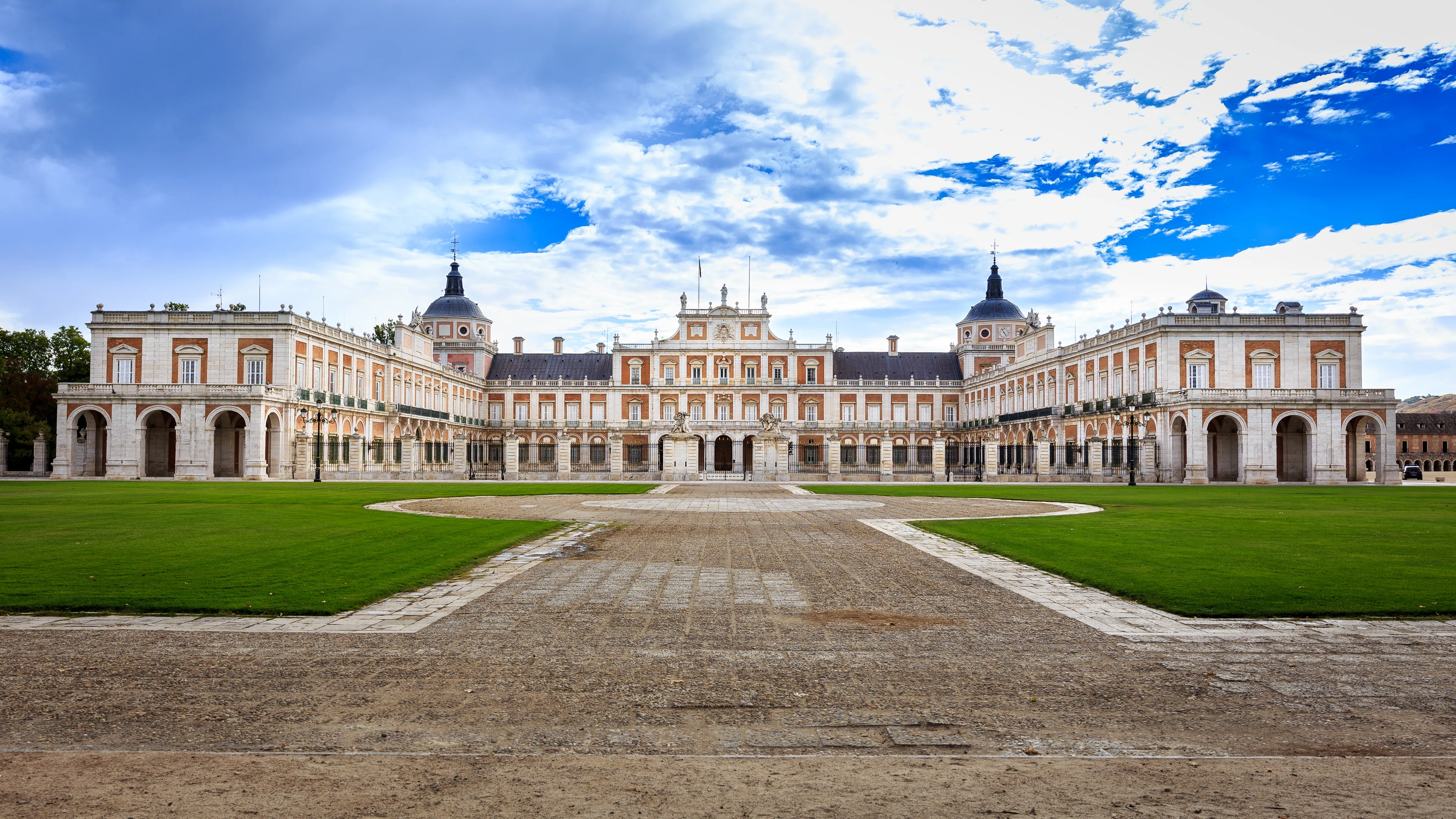
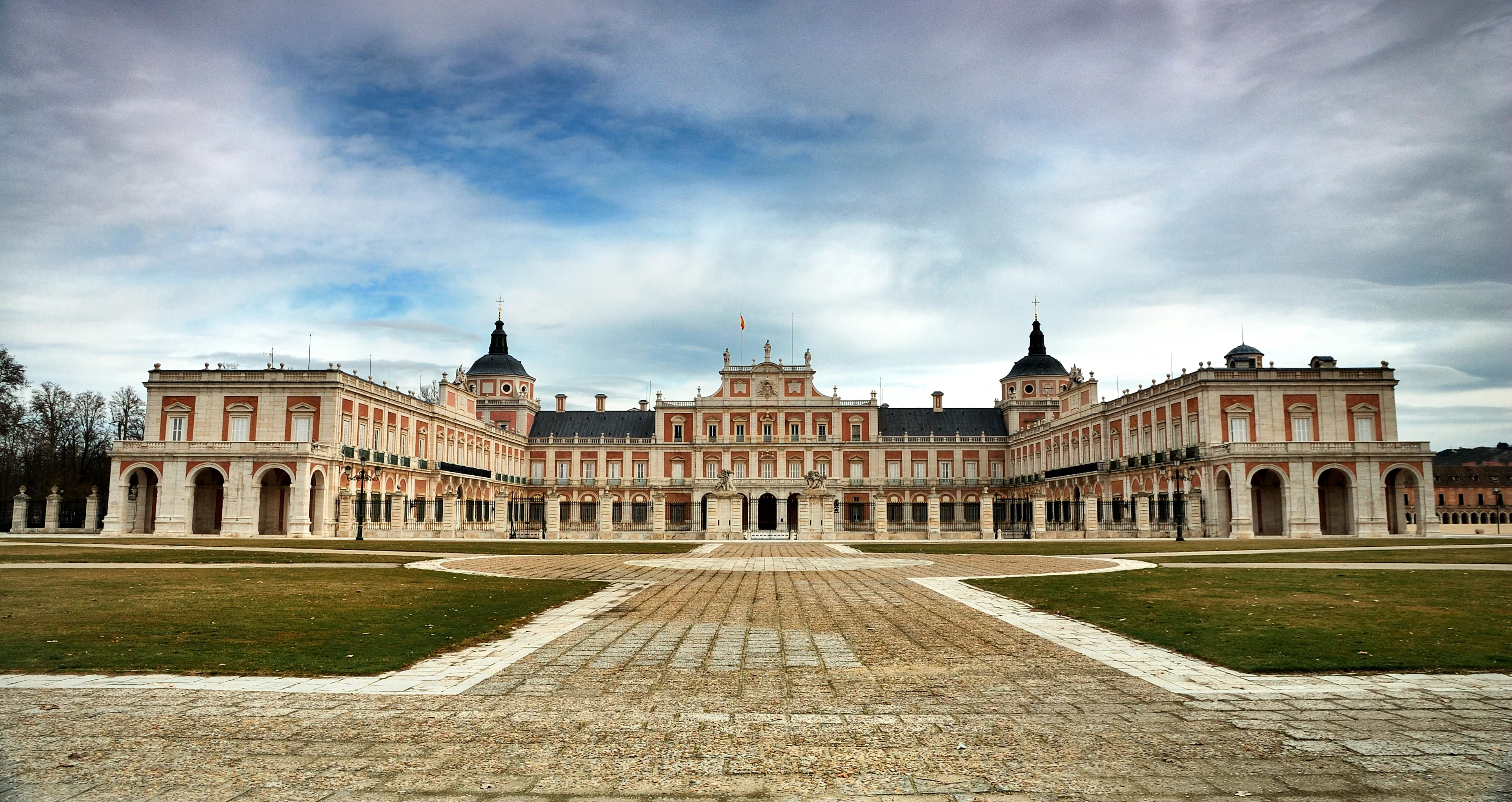
Grand Baroque palace with two domes and a symmetrical facade, surrounded by green lawns and a stone pathway under a blue sky

History of the Royal Palace of Aranjuez

The Royal Palace of Aranjuez originated as a royal property under Charles I in 1523, with Philip II commencing its development as a royal hunting lodge and seasonal court residence in 1561. Following a significant fire in 1748, the palace underwent extensive rebuilding and expansion by Ferdinand VI and Philip V, incorporating *late Baroque and Rococo styles* through architects like Francesco Sabatini. This grand residence also played a role in Spain's political landscape, notably with the 1808 Mutiny of Aranjuez. Opened to the public in 1931, its historical and architectural value was formally recognized in 2001 as part of the Aranjuez Cultural Landscape, a UNESCO World Heritage Site.

  • Established as a royal hunting lodge

    1561Founding

    The Royal Palace of Aranjuez was established in the 16th century by order of Philip II, initially serving as a royal hunting lodge. It became one of four seasonal seats of the court.

  • Initial palace construction began

    1561-1598Construction

    Philip II began the construction of the first palace on the current site, engaging architects Juan Bautista de Toledo and Juan de Herrera. By 1598, only the royal apartments, chapel, south tower, and part of the western facade were completed due to economic and political crises.

  • Palace reconstruction and expansion by Philip V

    1700Construction

    Philip V resumed work in 1700, adding a new north tower, completing the west facade, and defining the structure of the current palace, intending to rival the Palace of Versailles.

  • Palace rebuilt after fire

    1748-1752Renovation

    The palace was largely destroyed by fire in 1748 and subsequently rebuilt by Ferdinand VI. The new structure reflected the prevailing late Baroque style and 18th-century aesthetic.

  • Modern palace architecture by Francesco Sabatini

    1752Architecture

    Francesco Sabatini designed the two west wings, completing the main building that encloses the courtyard and defining the three sides of the main square. The construction was completed in 1752, as noted by inscriptions honoring Ferdinand VI.

  • Signing of international treaties

    Cultural significance

    Several international treaties were signed at the Royal Palace of Aranjuez, highlighting its historical importance as a diplomatic venue.

  • Deaths of Royal Family members

    1568-1828Notable person

    Several members of the Spanish royal family died in the palace, including Elisabeth of Valois (1568), Barbara of Portugal (1758), Elisabeth Farnese (1766), Maria Antonia of Naples (1806), Maria Isabel of Braganza (1818), and Maria Josepha Amalia of Saxony (1828).

  • Designated as property for the monarch

    1523Ownership

    The palace was designated as an exclusive property for the monarch starting in 1523, under Charles I of Spain, who established it as the 'Royal Woods and House of Aranjuez'.

  • Establishment of a botanical garden

    1551Collection

    In 1551, Charles I established a botanical garden to catalog new plant species brought from the Americas, though the mission was not entirely successful.

  • Charles IV's son builds Casa del Labrador

    Milestone

    Charles IV and his wife erected the pavilion known as the Casa del Labrador, an important example of European Neoclassical architecture, which is now open to the public.

  • Mutiny of Aranjuez and abdications

    1808Milestone

    In March 1808, the Mutiny of Aranjuez led to the abdication of Charles IV in favor of his son Ferdinand VII in the Salón del Trono, followed by Ferdinand VII's own abdication in May.

  • Constitutional Junta formed

    1808Milestone

    In September 1808, the Supreme, Central Junta was officially constituted in a ceremony held in the Chapel of the Royal Palace of Aranjuez.

  • Designated as state guest house

    1977-1983Ownership

    From 1977 to 1983, the palace served as a state guest house, indicating a temporary shift in its function from a purely royal residence.

  • Declared UNESCO World Heritage Site

    2001Heritage status

    The palace, gardens, and associated buildings were declared a UNESCO World Heritage Site in 2001 as part of the Aranjuez Cultural Landscape.

  • Declared Spanish Artistic Historical Monument

    1931Heritage status

    In 1931, the royal estate was declared an Artistic Historical Monument and opened to the public, marking a significant step in its preservation and accessibility.

  • Renaissance architectural style

    Architecture

    The palace is noted for its Renaissance architectural style, with significant contributions from architects like Juan Bautista de Toledo and Juan de Herrera.

  • Decoration enriched in 18th and 19th centuries

    1700-1899Architecture

    The palace's interior decoration was enriched during the 18th and 19th centuries with paintings, hardwood furniture, tapestries, clocks, and sculptures, many of which remain unique pieces.

  • Salón de Porcelana commissioned by Charles III

    1760-1765Architecture

    Charles III commissioned the Gabinete de Porcelana (Porcelain Room), a unique space lined with porcelain plaques featuring Rococo decoration of chinoiserie motifs, made by Giuseppe Gricci between 1760 and 1765.

  • Charles IV's collection of clocks

    Architecture

    King Charles IV was a collector of clocks, and numerous clocks of various sizes and characteristics adorn many of the palace halls, reflecting his passion.

  • Salón árabe created for Isabella II

    1847-1851Architecture

    The Salón árabe, a neo-Nasrid style room decorated with colored plasterwork, was created for Queen Isabella II between 1847 and 1851 by Rafael Contreras Muñoz, serving as a smoking room.

  • Italian Baroque and Rococo influences

    Architecture

    The palace showcases Italian Baroque and Rococo styles, evident in the late Baroque rebuild by Ferdinand VI, the west wings by Sabatini, and interior decorations like the porcelain room and the grand staircase.

  • Facade inscriptions detailing construction history

    1752Architecture

    Inscriptions on the central body's pediment, completed in 1752 by Ferdinand VI, state: 'Philippus II / Institvit / Philippus V / provexit' (initiated by Philip II and continued by Philip V) and 'Ferdinandu / VI Pius Felix / Consummavit / An MDCCLII' (Completed in 1752 by the faithful and devout Ferdinand VI).

  • Grand staircase by Giacomo Bonavía

    Architecture

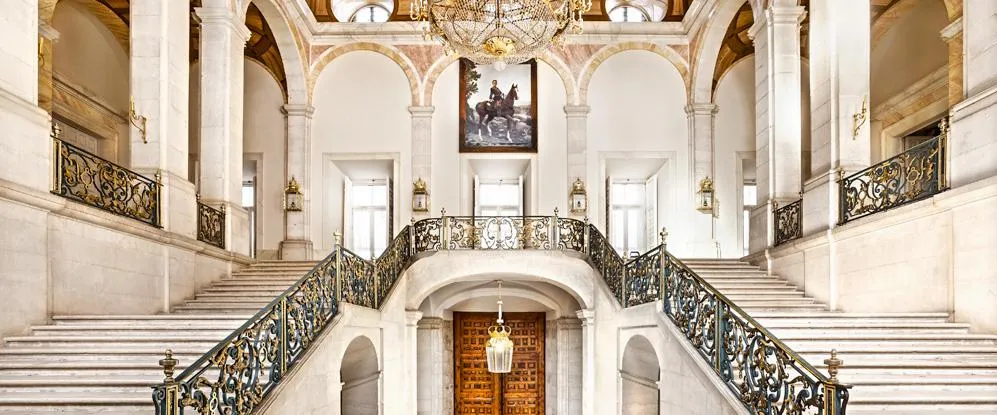
    The grand central staircase inside the palace's portico was created by Giacomo Bonavía at the behest of Ferdinand VI, featuring a black iron balustrade with gold trim in the Rococo style.

  • Neo-Gothic lamp in Queen's Music Room

    Architecture

    The Queen's Music Room features a bronze neo-Gothic lamp hanging from the ceiling, dating from the 19th century, complementing the Empire style mahogany furniture.

  • Mosaic gift from Pope Leo XIII

    Architecture

    The Queen's ante-oratory contains a mosaic made from tessera produced in the Vatican workshop, a gift from Pope Leo XIII to King Alfonso XII on his marriage.

  • Frescoes in Queen's Oratory by Francisco Bayeu

    1791Architecture

    The Queen's oratory, rebuilt under Charles IV, features stucco work and frescoes painted around 1791 by Francisco Bayeu y Subías, depicting various biblical scenes and figures.

  • Throne Room frescoes by Vicente Camarón

    1851Architecture

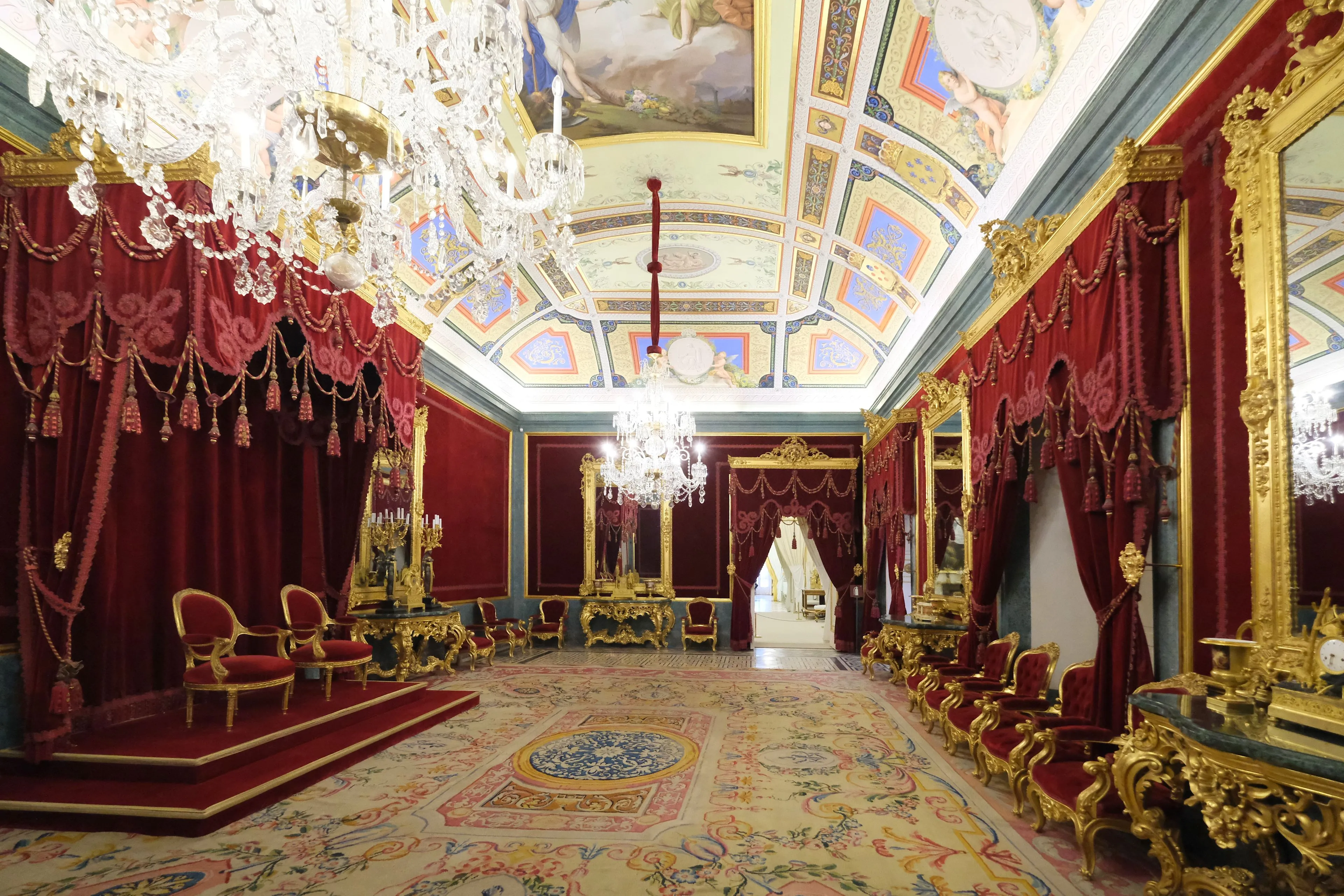
    The recessed dome of the Throne Room is decorated with Pompeian style frescoes by Vicente Camarón in 1851, representing the Monarchy through allegorical figures.

  • Queen's office vault frescoed by Mariano Salvador Maella

    Architecture

    The vault of the Queen's office is frescoed in Pompeian style by Mariano Salvador Maella with scenes from the Passion of Christ.

  • King's office vault frescoed by Juan de Mata Duque

    Architecture

    The King's office vault features frescoes in Pompeian style by Juan de Mata Duque, depicting allegories of the Liberal Arts.

  • King's study room vault painted by Juan de Mata Duque

    Architecture

    The King's study room vault, painted in Pompeian style by Juan de Mata Duque, complements the Carlos IV style furniture.

  • Chinese room vault frescoed by Zacarías González Velázquez

    Architecture

    The vault of the Chinese Room is frescoed by Zacarías González Velázquez with mythological scenes and countryside views, containing a collection of paintings gifted by the Emperor of China.

  • King's guardroom is one of the oldest parts

    Architecture

    The King's guardroom is one of the oldest parts of the palace, dating back to Philip II's time, and features six large paintings by Luca Giordano.

  • Formal dining room ceiling painted by Jacopo Amigoni

    1750Architecture

    The formal dining room ceiling was painted around 1750 by Jacopo Amigoni with moralizing symbology, depicting figures like Father Time, Truth, and virtues of the monarchy.

  • King's bedroom vault painted by Amigoni and Rusca

    Architecture

    The King's bedroom vault was frescoed by Jacopo Amigoni and Bartolomé Rusca, featuring allegories of Peace, Justice, and Abundance by Rusca.

  • Mirrors' room ceiling frescoed by Juan de Mata Duque

    1803Architecture

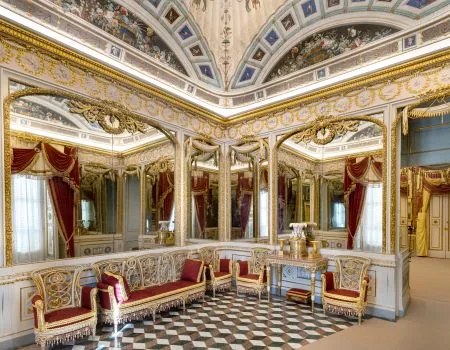
    The ceiling of the Mirrors' room, used as a dressing room for Charles IV, is frescoed in Pompeian style by Juan de Mata Duque around 1803.

  • Queen's bedroom vault frescoes by Zacarías González Velázquez

    Architecture

    The Queen's bedroom vault is decorated with tempera frescoes by Zacarías González Velázquez, depicting allegories of Science, Virtue, Art, Law, and Monarchy.

  • Queen's boudoir vault painted by Vicente Camarón

    Architecture

    The vault of the Queen's boudoir is painted by Vicente Camarón with representations of the seasons.

  • Seasonal seat of the Spanish court

    Cultural significance

    The palace served as one of four seasonal seats of the Spanish court, indicating its historical role and importance in the monarchy's movements and administration.

  • Architects involved in construction and design

    Notable person

    Key architects involved in the palace's design and construction include Juan Bautista de Toledo, Juan de Herrera, Francesco Sabatini, Giuseppe Gricci, and Rafael Contreras Muñoz.

  • Renaissance architectural style

    Historical period

    The palace exhibits a Renaissance architectural style, with early contributions from prominent architects of the era.

Got Questions About the Royal Palace of Aranjuez?

Curious about the Royal Palace of Aranjuez? Whether you're wondering if this grand residence in Aranjuez is open on a Monday, or precisely how to arrive, our FAQs have the official scoop. Find practical answers to all your pressing questions for a smooth visit.

Does the Royal Palace of Aranjuez have free entry?

Yes, free admission is available for children under 5 years old, unemployed individuals with valid proof, and visitors with disabilities. Additionally, free general admission is available on Wednesdays and Sundays during specific afternoon hours for EU and Latin American citizens or residents, as well as on select holidays.

Are there discount tickets for students and seniors at the Royal Palace of Aranjuez?

Yes, reduced tickets are priced at 4.00 EUR. This discount applies to students up to 25 years old with a valid student ID, seniors aged 65 and over, and children aged 5 to 16.

What are the ticket prices for the Royal Palace of Aranjuez?

Standard adult admission for a self-guided tour of the Royal Palace of Aranjuez is 9.00 EUR. Please note that an additional booking fee of 0.77 EUR applies per paid ticket.

How much is the Royal Palace of Aranjuez entry fee for children?

Children aged 0 to 4 receive free admission. Children aged 5 to 16 qualify for a reduced ticket price of 4.00 EUR.

Planning Your Visit to the Royal Palace of Aranjuez

When preparing for your visit to the Royal Palace of Aranjuez, remember that the last access for the main palace is daily at 6 p.m. Photography is allowed without flash for personal use in most areas, but tripods and selfie sticks are not permitted. Free access to the Royal Palace is offered on Wednesday and Sunday afternoons from 3 p.m. to 7 p.m., with the last entry also at 6 p.m. For practical planning, be aware that 200€ and 500€ bills are not accepted at the ticket office. Distinct access points are used for different parts of the complex: the main Royal Palace entrance in Aranjuez is at the Plaza de Parejas facade, while Casa del Labrador is accessed from the Prince's Garden, and the Royal Barges Museum can be reached via the Prince's Garden or a walkway over the Tagus river.

Who Will Enjoy the Royal Palace of Aranjuez?

The Royal Palace of Aranjuez in Aranjuez welcomes a diverse range of visitors, including families, couples, solo travelers, and groups. It is especially suited for those with an interest in history, architecture, design, and local heritage. The site also accommodates individuals with accessibility needs, ensuring a more inclusive experience. Guests are permitted to take photographs without flash for personal use in most areas, though restrictions apply to accessories like tripods and selfie sticks.

Photos of the Royal Palace of Aranjuez

Explore the visual grandeur of the Royal Palace of Aranjuez, a World Heritage site showcasing magnificent Baroque exteriors with symmetrical facades, domes, and expansive green lawns. The photo gallery captures both the palace's impressive architectural scale and its opulent interiors, featuring grand staircases, gilded rooms, and elaborate historical details. Visitors can anticipate views of royal splendor and extensive gardens.
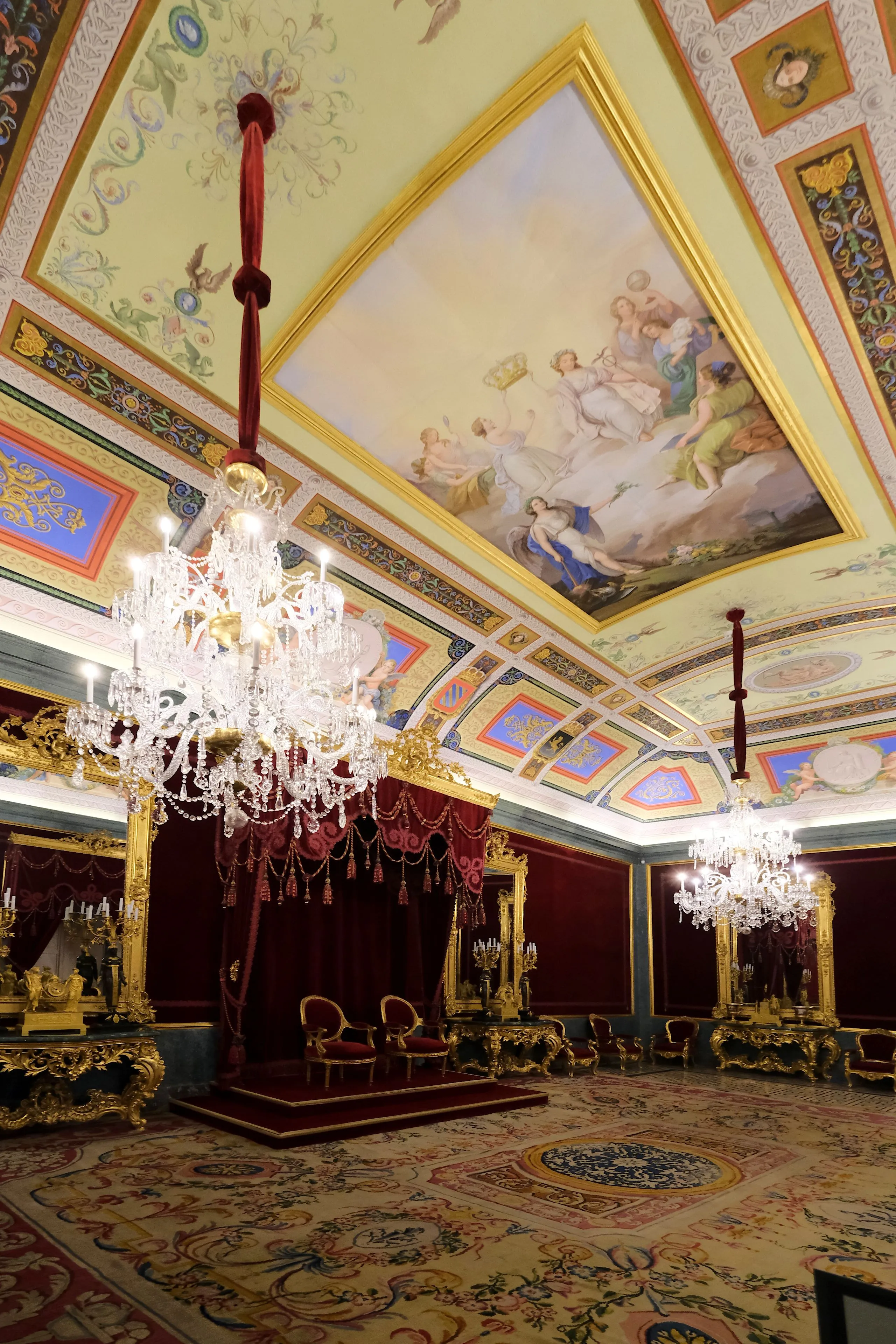
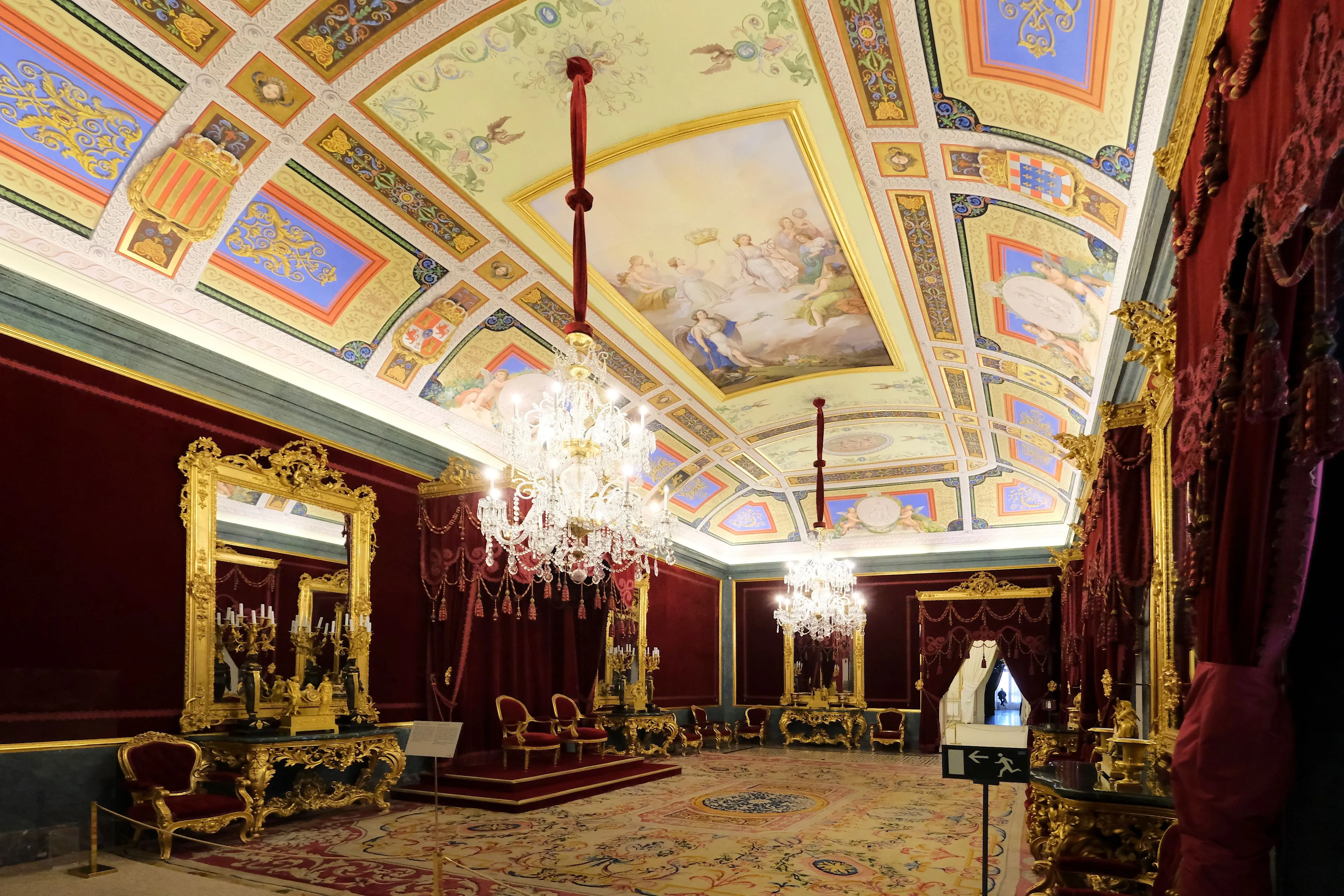
Ornate interior of the Royal Palace of Aranjuez with a large chandelier, frescoed ceiling, and a throne under a red canopy.
Ornate interior of a royal throne room with gold furniture, red velvet drapery, a large chandelier, and a painted ceiling with decorative panels
The Royal Palace of Aranjuez with its ornate facade, arched entrances, and a Spanish flag flying atop the building.
A wide view of the Royal Palace of Aranjuez, a large classical building with multiple wings and towers, set against a cloudy sky, with a paved courtyard and green lawns in the foreground.
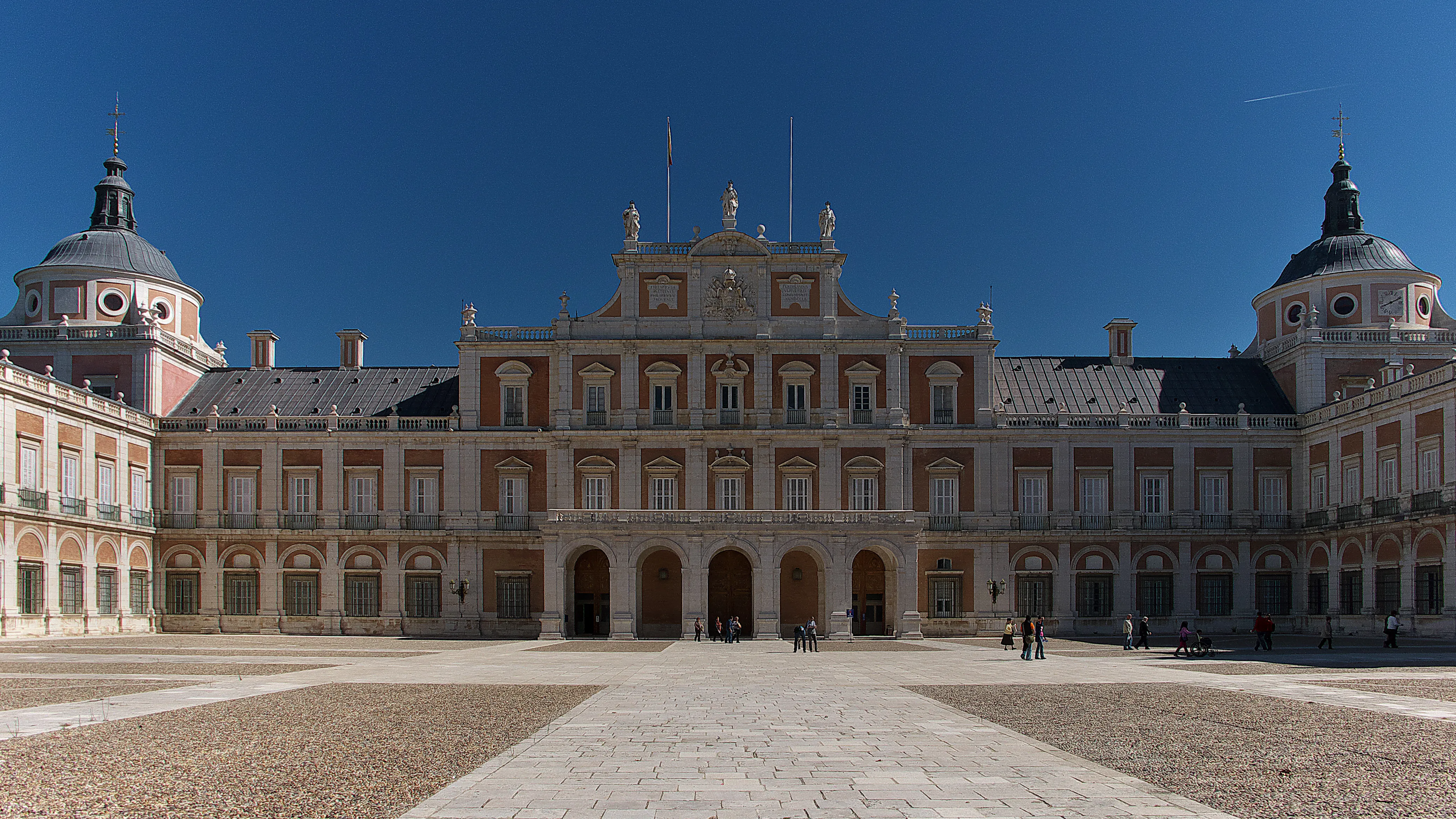
The Royal Palace of Aranjuez with its ornate facade, twin domed towers, and central courtyard under a clear blue sky
Grand staircase with ornate railings and chandelier in the Royal Palace of Aranjuez
Grand neoclassical palace with symmetrical wings and domes, surrounded by green lawns and a stone pathway under a clear blue sky
Ornate interior room with gilded mirrors, red velvet chairs, and a checkered floor
Grand Baroque palace with two domes and a symmetrical facade, surrounded by green lawns and a stone pathway under a blue sky
Opulent throne room with red velvet drapery, gold gilded furniture, a large chandelier, and a painted ceiling
Madrid

Find Madrid Museums: Search for Cultural Attractions and Historical Sites

Discover art, history, and unique cultural experiences throughout Madrid.

Locate inspiring museums in Madrid that match your specific interests. Uncover a wide range of cultural institutions, from renowned art galleries to captivating historical collections. Start your discovery of Madrid's vibrant cultural landscape now.

Explore Royal Palace of Aranjuez with Madrid
Guides, visitor info, and museum details in Madrid
Find everything about Royal Palace of Aranjuez in one place, including tickets, opening hours, current exhibitions, location details, visitor tips, nearby attractions, and the latest museum updates. Use these pages to plan your visit, discover what to see, and get practical information before you go.
Discover nearby museums similar to Royal Palace of Aranjuez in Madrid and plan your next cultural stop with confidence.
These recommendations prioritize real proximity to Royal Palace of Aranjuez and help you find high-fit alternatives faster across Madrid.
Use this curated list to compare museums near Royal Palace of Aranjuez without opening multiple search pages. Each card gives you fast visual context and direct access to key details so you can decide quickly. If you are building a full day in Madrid, this section helps you chain nearby visits with less planning effort.