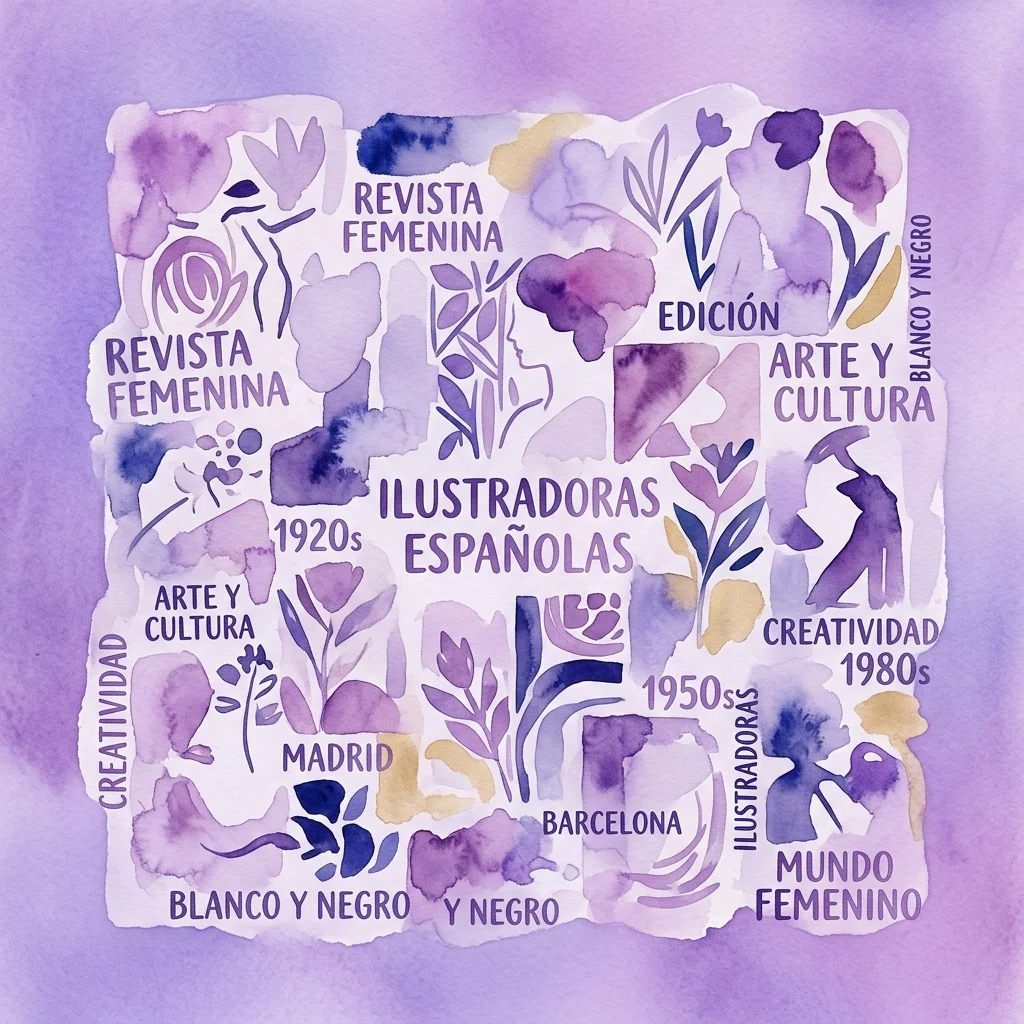
This exhibition, hosted at the Imprenta Municipal – Artes del Libro, highlights the lettering work of four illustrators from the Colección ABC who contributed to publications like Blanco y Negro and Diario ABC. It explores how these artists approached letterforms from an illustrative perspective, responding to editorial needs and the aesthetic currents of their time.
The exhibition 'Letras de Cabecera. Rotulación en la Colección ABC', presented in collaboration with the Imprenta Municipal – Artes del Libro, delves into the world of lettering as practiced by four illustrators from the Colección ABC. These artists, who worked for publications such as Blanco y Negro, Diario ABC, and their supplements between the late 19th century and the 1970s, approached typography from an illustrative rather than a specialized design standpoint. Their work responded to editorial composition needs and the prevailing aesthetic trends of their respective eras.
In the early days of illustrated press, lettering, or what is known as lettering, was more closely aligned with illustration and editorial design principles than with strict typography. Positioned between calligraphy and typography, lettering held its own distinct discipline. Within editorial design, these pieces served dual purposes: identifying sections or regular spaces within a publication, their forms reflecting the stylistic criteria of the moment, and acting as visually impactful elements to capture reader attention, anticipate or reinforce text content, and encourage reading. The selected examples in this exhibition embody these objectives, functioning both as content identifiers and as impactful visual elements, each representative of its creation period's aesthetic currents. The exhibition features designs by Eulogio Varela (1868-1955) in the Art Nouveau style; Francisco López Rubio (1895-1965) whose work reflects Art Deco codes and the influence of early 20th-century avant-garde movements and Bauhaus typographic rationalism; José Francisco Aguirre (1921-1984), art director of Blanco y Negro from 1957; and Lorenzo Goñi (1911-1992), a prominent illustrator for ABC and Blanco y Negro, whose contributions align with expressive aesthetic principles linked to the New York School and Pop Culture concepts. The exhibited pieces also served as the foundation for a typography workshop focused on developing complete alphabets that can be used as digital fonts.